12th January 2026
One of the most noticeable changes I’ve seen over recent years is how global many families have become. Families now live, study and work across continents, and that inevitably shapes how they think about their role in the world.
As families become more internationally mobile, their giving often becomes more global too. That has been one of the more interesting shifts to observe. Philanthropy begins to cross borders in the same way people’s lives do, and with that comes the possibility of connection rather than fragmentation.
Is philanthropy’s role in creating a global society being overlooked?
I’ve often found myself reflecting on whether philanthropy can play a wider role here. There is such a strong global movement happening in philanthropy, and it has the potential to act as a unifying force, helping people think differently about shared global challenges and connection, wherever they are in the world. I don’t see this as a finished idea, but as an open question about where philanthropy might take us next as a global society.
Finding those with shared values and expertise
From there, my thinking often turns to how people want to contribute. For many donors, it isn’t simply about giving money. I’ve worked with individuals who want to apply their business expertise to causes they care about, and who are drawn to philanthropy that feels entrepreneurial and relevant.
I remember one conversation in particular, where someone said to me, “All people do is they just want my cheque, whereas actually I’m quite a successful guy, why can’t I apply that success to something really entrepreneurial in the charity sector?” That thinking led him to become closely involved in a charity where his skills and experience were as valued as his financial support.
What this has reinforced for me is that philanthropy can take many forms. There are people out there who would love to do more, if they could clearly see how their skills, ideas and experience could be used — not just their ability to fund it.
Inspiring younger generations and building skills
Importantly, these ideas don’t begin at scale. They often start within families, and sometimes with very young children. I’ve seen how simple approaches can be powerful like separating money into saving, spending and giving not as a lesson, but as a way of starting conversations about values.
I’ve also seen families bring different generations together around a small pot of money and invite everyone to share ideas. The amounts are often modest, but that isn’t the point. What matters is the experience: practising how to listen, how to speak about values, and how to make decisions together. It doesn’t have to be complicated, and it rarely is.
When I look across these different experiences – global giving, people wanting to contribute their skills, and families involving the next generation – what stays with me is how often philanthropy brings people together.
Sometimes that connection is across borders. Sometimes it’s across generations. And sometimes it’s simply around a shared sense of what matters.
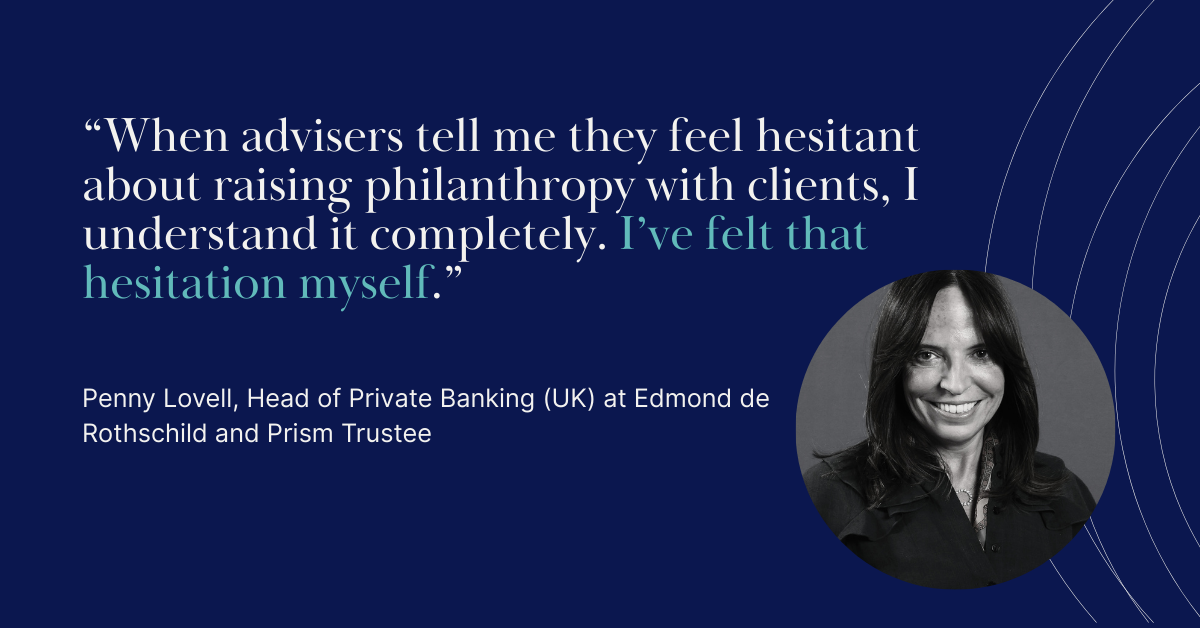
Penny Lovell is Head of Private Banking (UK) at Edmond de Rothschild. She has spent over 25 years advising High Net Worth families across Coutts, Fleming Family & Partners, Close Brothers, Sanlam Private Wealth, and Citi Private Bank.
She’s also a long-standing trustee of Prism the Gift Fund, a recognised voice on the role of philanthropy in wealth management, and champion of the need for advisers to make giving conversations a core part of client relationships.