12th January 2026
When I began my career in wealth management, philanthropy was often seen as something separate – something families might think about after their main wealth planning was done, if they thought about it at all.
Over time, that has changed and quite fundamentally.
What I see now, particularly over the last decade, is philanthropy moving much earlier into conversations with clients.
The change hasn’t come from clients asking directly about philanthropy. It’s come from a broader shift in how people think about wealth — and from advisers feeling more confident bringing those conversations into the open.
A move towards more values-led decision making
Today, I see clients placing much greater emphasis on meaning and legacy, alongside financial performance. There is more focus on how wealth reflects values, how it is preserved across generations, and how it can have value beyond the family itself.
The power of intergenerational giving and identity
Philanthropy plays a powerful role in families because it helps them articulate purpose and define their values across generations. It gives language to ideas that are often felt but not yet expressed. When families start talking about giving, they are often really talking about identity – what they stand for, what matters to them and how they want to be remembered.
I’ve seen this play out in very personal ways. One adviser I know worked with a next-generation client who wanted to support environmental causes in memory of his grandfather, who had been deeply passionate about conservation. The conversation wasn’t about structures or scale; it was about honouring a relationship and carrying values forward. The result was not just a charitable fund, but a much deeper sense of trust and connection between adviser and client.
Building stronger family connection
Philanthropy also has a quiet way of bringing families together. It creates space for conversations that don’t always happen naturally – across generations, between siblings, and sometimes between very different viewpoints. Those conversations can be challenging, but they are often incredibly grounding.
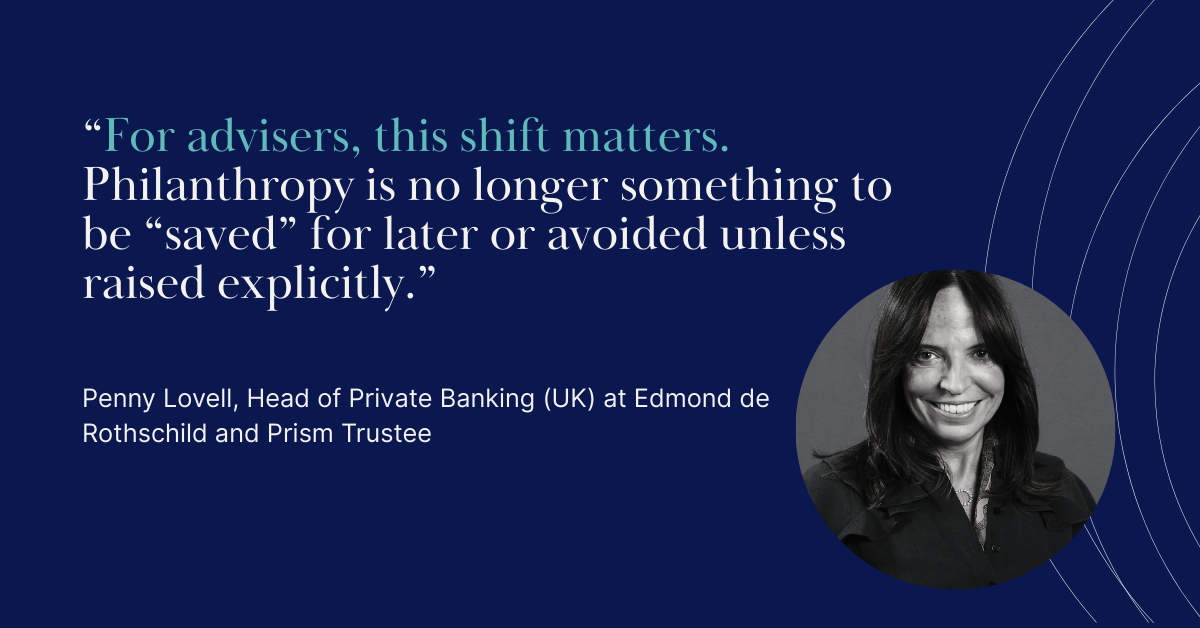
For advisers, this shift matters. Philanthropy is no longer something to be “saved” for later or avoided unless raised explicitly. It has become part of a broader, more human conversation about wealth — one that acknowledges clients as people, not just portfolios.
What I’ve learned over time is that these conversations don’t need to be perfect or polished. They simply need to be open. When philanthropy sits at the heart of the relationship, it often strengthens everything around it.
Penny Lovell is Head of Private Banking (UK) at Edmond de Rothschild. She has spent over 25 years advising High Net Worth families across Coutts, Fleming Family & Partners, Close Brothers, Sanlam Private Wealth, and Citi Private Bank.
She’s also a long-standing trustee of Prism the Gift Fund, a recognised voice on the role of philanthropy in wealth management, and champion of the need for advisers to make giving conversations a core part of client relationships.