14th November 2024
Scientific-research and the role of philanthropy, and how we can shape the future of giving, was the focus of the first event to celebrate our 20th anniversary.
There has always been a strong personal connection between science, medical research and philanthropy. Curing diseases, alleviating suffering, and improving people’s lives are strong motivational factors. When it’s yourself or a loved one, the strength of this can go into overdrive and has led to some incredible medical breakthroughs – especially in under-researched areas.
But it’s a complex arena that comes at a financial and emotional cost.
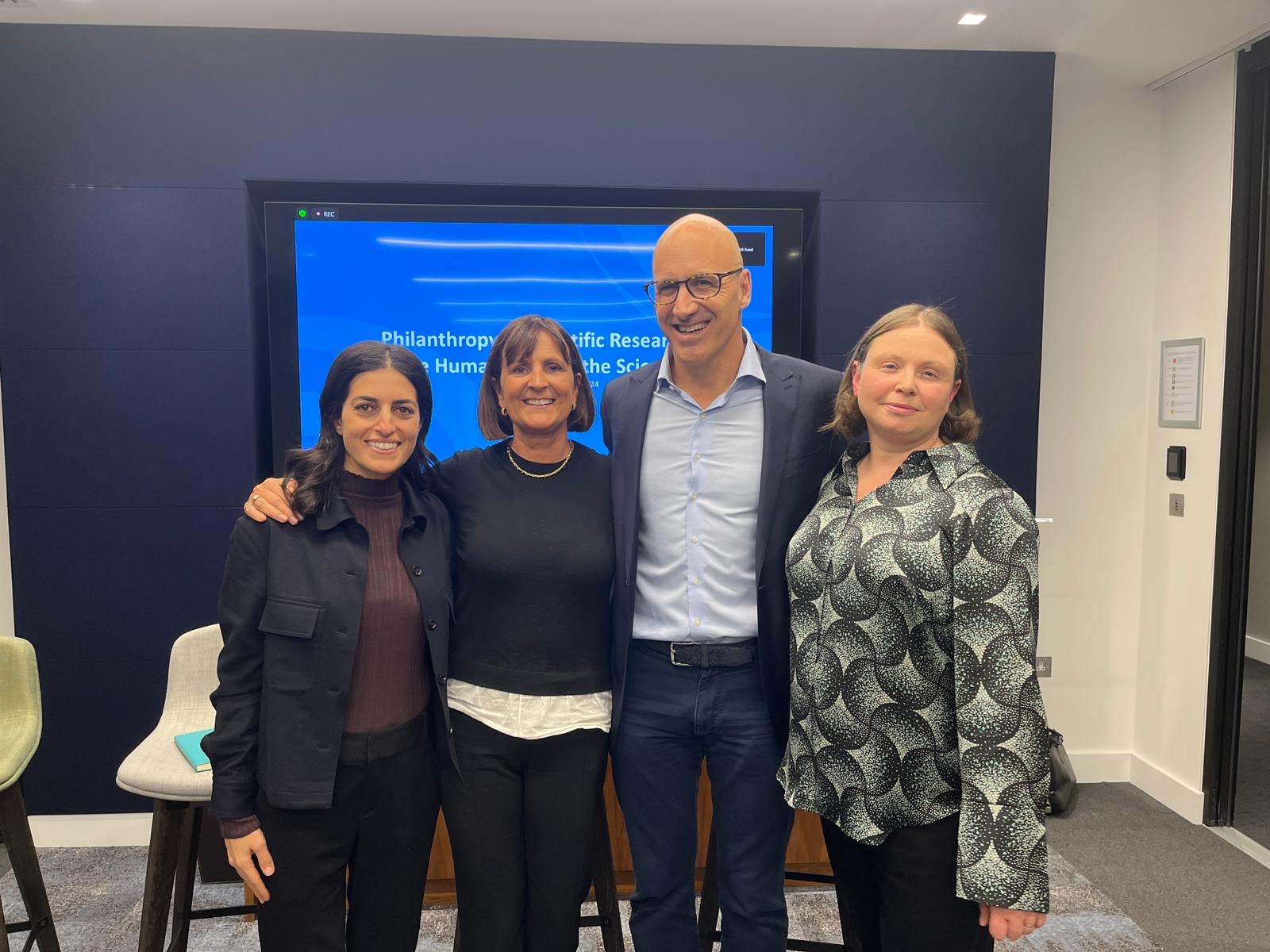
The panel at our Scientific research and Philanthropy event shared their personal stories, challenges and breakthroughs. All are parents of children who have rare medical conditions; they are each on a steep learning curve and use sheer determination to fund medical research and build supportive communities.
Each has set up their project under Prism, either through a DAF or the Collective Fund model. This allows founders to raise and direct funds towards the causes they care about, safe in the knowledge that administration, due diligence and governance is being handled by Prism.
Opening the Conversation: Why Philanthropy matters in scientific research
The panel was chaired by Diana Noble, who brought her extensive knowledge in financing and developing medical research. She currently sits on the board at The Wellcome Trust, which allocated £1.2billion in research grants in 2023. She also sits on the board at The Bank of England and is a leader in venture capital and global development.
Key themes from the discussion
The personal Connection behind every cause
Opening our event were Riccardo Zacconi,co-founder of PTEN Research Foundation and King.com creators of Candy Crush, Leila Rastegar Zegna founding member of the Kabuki Syndrome Foundation and founder of Kindred Capital, and Caroline Olshewsky co-founder of the Foundation for ARID1B Research (FAR) and CEO of Lupus. They shared how they started on this journey and their motivations.
The golden thread connecting them all is that each has a child with a rare medical condition.
Riccardo Zacconi noted: “When you make some money, what you do with the money? The most important thing is for your kids.” It was 10 years ago when he found out his son had a rare medical condition and, like most parents in this situation, he started with a google search.
“I come from tech, not from life sciences. I had no idea about this area, and you can’t make it up, like in tech,’ he laughs. “I started googling, and I found out who was the expert, and then from there, it was a journey to learn more.”
This was more than just ‘sending the cheques.’ It is deeply personal, and he underlined the importance of having to commit himself fully to the cause for a long time.
Caroline Olshewsky described how you can feel ‘unbelievably alone.’
“When [my child] was diagnosed at two, there was one paper written on 145 children, which I wish I hadn’t read. It was so soul destroying and sad. And then I came across another parent on Facebook who had posted saying, I’m not a scientist, but science is moving. Is there anybody else out there who wants to see what we can do? That was two and a half years ago, and it was the beginning of the journey that we will be on for the rest of our lives.”
When Leila started looking into Kabuki syndrome, there were only thirty known cases with the same variation as her daughter. The reports she found left her afraid to reach out to the parent community because she was worried about projecting what her daughter would or wouldn’t be.
“I went very much down the medical route of saying, who can I find that is working in this condition, who are the physicians and researchers publishing in this space? And that is how I found my way.”
The importance of failure and the ripple effect of medical research into rare conditions
Leila emphasised the impact of personal connection in driving research.
Some conditions may be so uncommon they affect only a single person. Leila was clear that we should not feel discouraged by the rarity. The energy given to researching even one rare disorder can create a ripple effect, leading to breakthroughs in other areas of medicine and ultimately benefiting many more people.
This is why Leila advocates strongly for incentives and knowledge sharing, because a breakthrough in a new pharmaceutical drug, for example, may also apply to another rare condition:
“We see a tiny fraction of [the medical research] that have had success… 99% of spend is on things that don’t actually get published, and then we just repeat the same mistakes all the time. The vast majority of spending goes towards failed studies. So it’s vital this data is available.”
Leila suggested creating a repository to publish everything, including failed studies and experiments across the medical and scientific research industry to avoid spending money, time, and resources on repeating studies known to not work.
Navigating the challenges of funding rare disease research
The high risks associated with funding early-stage scientific research makes funding projects challenging. As Diana Noble noted: “Private sector and government can’t do everything, and they quite often don’t get it right either. So, there’s a huge gap for philanthropy to fill.
“What I’ve seen is that philanthropy, without the constraints that come with effectively spending or giving away taxpayers’ money, can take much higher risk and can have a much longer perspective.”
She went on to say that philanthropy isn’t easy either, so the structure offered by organisations like Prism are crucial in helping get money to where it is needed most. She asked the panel how it has helped them.
Caroline explained that when they began their journey, they weren’t ready to set up as a charity but they had people wanting to give them money.
“We got in touch with Prism and said: Can you help? And they said ‘Yes.’ They gave us a huge amount of time to help us understand how it could work and to understand who we were, what we needed and how that relationship could function. It’s an incredibly structured, supportive environment.”
Working with Prism gives donors confidence that money is being used correctly. Leila says having a collective fund has transformed fundraising, making a huge difference to their community and their willingness to give. Riccardo reflected on how quick the team are to respond and get money to where it needs to be.
Securing funding is a challenge, but so is time and getting the right team in place. All the panel are balancing their busy professional and personal lives and are parents of children who may have high needs. As Riccardo mentioned, internet searches and books will take you so far; you need the right people around you.
The Role of Strategic Partnerships and Collaboration
Caroline shared insights into how patient-led organisations can drive research and innovation by uniting stakeholders and creating a sense of community around these causes. Researchers are open to working much more closely with patients to understand these rare conditions. As a result, there are increasing numbers of stakeholders and donors who wish to invest in causes.
Riccardo also touched on how generous the scientific community can be, with Leila pointing out that cold calls in tech might be met by a silence but, when calling about research, they had an incredible response.
Opportunities and challenges ahead
So what lies ahead for these philanthropists and those who will eventually travel a similar path? As Caroline poignantly put it, it is not always about the money; dedicating time is vital in philanthropy. All the panel learned the landscape through persistence, building connections with families and experts, and identifying key research needs.
What was clear from the discussion is that Philanthropy plays a critical role in funding the long-term research required for rare diseases. As Leila pointed out: “The role of philanthropy is not just important, but it is existential in a rare condition that doesn’t have a body of knowledge and foundational research already done. You cannot unlock industry money or NIH Health money, without having fundamentally done some of the groundwork.”
Looking to the Future: Shaping Philanthropy’s Role in Medical Innovation
Over the last 20 years, Prism has channelled over £41 million into different health charities and causes. Our hope is that the experiences of our collective funds and donors will inspire more people to give and will continue to shape the future of giving.
In that time, we’ve raised over $1 billion and distributed over $500 million. As we celebrate our anniversary in 2025, we will discuss big issues in philanthropy and look at the impact of our other collective funds and donors.